BREBBIA PIPES – PART 2

In 1968 MPB was changed to “Brebbia”. In the same year, a slow smoking competition was held in Varese, and Enea took advantage of it. He created a team from his employees and toured Europe, bringing home multiple wins. Soon Brebbia pipes were popular in the international market, not only for their quality and designs but for their “sweet smoke.”The combination of Varese’s environment and extreme humidity levels allowed Enea to naturally cure the briar and reduce the tannin levels within the briar. By doing so, the bitter taste that a new pipe has during the first smoke was gone.

The 1970s were difficult years for the pipe business. The public slowly drifted away from the slow smoking culture, and the few that remained became more demanding than ever. Innovation, diversification, and imagination became more than ever the keys words for success and survival in the ever-diminishing tobacco pipe business. A notable invention was born in the late 70s, the frangifumo (smoke breaker) mouthpiece. Instead of one single opening, it had multidirectional channels, allowing the smoke to be less concentrated in one spot and reducing the famous tongue bite.

In 1977, one of Enea’s children, Luciano Buzzi, joined the family business ranks. As his fathers once did, he started traveling abroad to revamp the brand. Once he mastered the craft, Luciano became an active member of the creative team and created his first line in 1979 called 79. The German market (as we know prefers long-stemmed pipes) was looking for a filtration system. A 6mm filter was fitted into the pipes, but it was not enough. A new challenge was presented to Luciano, to fit a 9mm filter but keep the slim silhouette of a churchwarden pipe. Four years later, the 83 line came to life. Now all Brebbia pipes come with a 9mm filter slot, but an adapter is available for those who dislike filters.

In the following decades, multiple lines of pipes have been created, such as “Great designers of pipes” designed by influential pipe makers, the freehand line “linea A”, and many more. In 1992, Enea refurbished a large warehouse in Bosco Grande and created a pipe museum, where models from various producers and his own are displayed.

To this day, the Brebbia company stands for innovation and reimagination, always looking for new ways to improve tobacco pipes by bringing new techniques and trend-setting designs to the market. If you are looking for a new favorite, have a look at our Brebbia selection, and I’m sure you will soon fall in love with them.

With a Brebbia in my hand, I send you my regards.

Till my next post!

Chris
Brebbia Pipes – Part 1

Ready for a trip to Italy? I hope so because today I’m going to talk to you about Brebbia Pipes.

Let me introduce you to our main character: Enea Buzzi, founder of the Brebbia Pipes Company. He had in his family many entrepreneurs: his uncle Bernardo, who made a fortune in London, his grandfather, who built a small power plant in Brebbia; and his father, Carlo Andrea, who founded a weaving mill in Gavirate.

Enea was in Varese’s train station and was smoking a Rossi pipe, and it started to pour. He wondered how he could smoke while under the rain, and that’s how the pipe with a lid idea was born. The Rossi family developed this concept and started producing their take. After different business attempts, Enea was still not happy, and he decided to focus on his passion and produce tobacco pipes. Money was short, which meant expensive machines and a location for his company were not easy to achieve.

That’s where Uncle Bernardo came to play in this story. “Papa” Bernardo, as his family called him, backed up his nephew’s dream. He didn’t bring to the table only the money but also a meaningful family connection: his niece, who was married to Achille Savinelli. The Savinelli family was also looking into opening their tobacco pipes production, but that’s for another time.

In 1947 Enea and Achille founded a tobacco pipe company, but the partnership didn’t last long. The business couple didn’t share the same vision for the company. Enea went to London to establish his name in the international market, and Achille founded his factory in Molina di Barrasso.

From 1947 Enea made pipes using the Savinelli logo, but after 1953 he started using his own trademark MPB (Manifattura Pipe Brebbia). The following year, a fire destroyed the Brebbia factory, which allowed him to build a bigger one. Enea also bought a foundry to develop an aluminum base for his pipes, but the market didn’t respond well to that.

In 1956 the bumpy partnership ended between Enea and Achille, and a new prosperous era started for MPB Pipes. Innovation, diversification, and imagination were the keywords.

Christian

Different Pipe Styles… Which one do you prefer?

We have the basics down of what a tobacco pipe is and its finishes. Now I will introduce you to some of the many shapes you can have. Most of us got to know pipes by watching movies with Sherlock Holmes and his Calabash pipe. This kind of pipe is quite peculiar but not for the shape only, let me explain why.

Blatter is the creator of this kind of pipe. I will try to be brief; during the Boer War, briar was scarce, so Blatter had to find a new material to use and chose Calabash gourd. You are not mistaken; this pipe is made out of a pumpkin with a meerschaum bowl and a plastic stem. The Calabash has a dramatic bend in the pipe’s body, nearly assuming the shape of a “U” and has a drastic but gradual and uninterrupted taper from bowl to stem.

Nowadays, this shape is also made in briar but is not as dramatic as it would be in Calabash gourd. Once the choice of the soldiers during wartime, then (after King Edwards made smoking fashionable) the new trendy smoking pipe of English society and now a rare beauty.  

Billiard pipes are the most common, straight, bowl height like the shank length, a timeless shape. This shape also has a bent variation, with the same principle. 

The Apple shape can be either straight or bent, the same proportion of a billiard but with the bowl rounded off like an apple would be, Easy! 

The Bulldog shape is apple’s edgy brother with a squared shank and some horizontal lines carved onto the bowl. If you are not into corners but like bulldogs overall shape, a Rhodesian is the one then. 

As always, these pipes can come either bent or straight. 

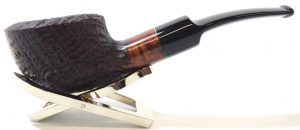
If you are looking for symmetry, then look no further. The Poker shape is the right one for you. It is turned on a lathe with two cylinders at 90-degree angles to each other, the larger for the bowl and the thinner for the shank. Simple but perfect. Can you top perfection? yes, you can! This pipe has a flat base which allows you to put it down without a stand. I know, mind-blowing.  

Are you looking for a long relaxing hand free smoke? Pick a Hungarian Shape/Oom Paul, and you won’t be disappointed.

Some people like to distinguish the two by defining them by the bowl shape and proportions: full bent Apple(Hungarian) or Billiard(Oom Paul). Either way, generously sized tobacco chamber, fully bent with a shank about the same diameter as the bowl. This shape allows you to have long and relaxing smokes and allows the pipe to rest on your chin, so you don’t have to clench your pipe.
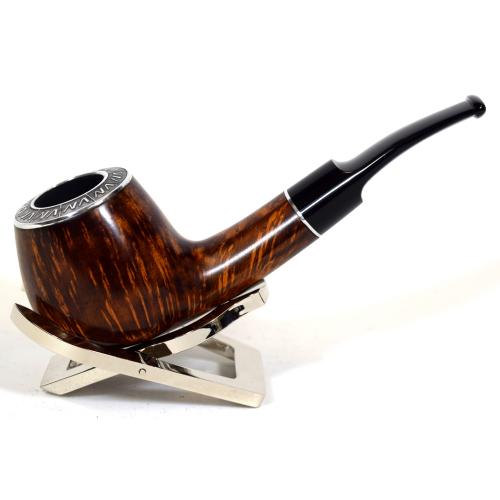
Quick history note: State President of the South African Republic, Stephanus Johannes Paulus Kruger, known as Paul Kruger and called by his people Uncle Paul (Afrikaans: “Oom Paul”), used to have a Hungarian pipe sitting on his beard all the times and was also known for that, hence the origin of this pipe shape second name. 

Speaking of a bearded man, I’ve had some people coming to the shop looking for “Gandalf’s pipe”… They were looking for a Churchwarden pipe. Many iterations of this shape, different lengths, bowl shapes, and finishes, but the general rule is that it has to be a long-stemmed pipe with a relatively small bowl. This shape is ideal for people who like long, cool smoke and they like to read. I know that’s oddly specific, but in Europe is called the “reading” pipe, so i guess you could try it if you like reading. 

One shape leads to another one, ready for another chain of shapes? 

A Dublin is a Billiard with a bowl that tapers out, the same proportions, and the bowl is slightly angled away from the face. A Zulu shape is a curved Dublin with the bowl more on an angle.

A shape that I like a lot is the Chimney shape, great if you want to pack a good amount of tobacco. It’s a Billiard variation, with a chimney(bowl) that is about 50% taller, which means around twice the length of the shank. Use it as a general idea. 

I’m going to close this post with my favorite shape: the Horn shape. In my opinion, it is one of the most elegant pipe shapes. It has no “junction” between the bowl and the shank. The lines flow seamlessly back and forth along the length of the pipe. The defining characteristic of the Horn is its continuous and uninterrupted taper from front to back. Only the imagination is the limit: square, round, or freely shaped bowls, full of details or completely plain with one or multiple types of finishes. Just stunning. 

As you can imagine, there are many more shapes, but I will let you discover them. Head over to our guide, in which we go in-depth on each shape available. 

Christian – Pipe Expert


Different Pipe Finishes… Rustic, Sandblast or Smooth?

Last time I wrote about where to start with pipes and why but not about their finishes! So, does finish matter when it comes to the smoking experience?

The only thing that the finish will be affecting is the briar’s heat dispersion. The bigger the surface is, the more heat dispersion you will have. A pipe with a rustic/sandblast finish will be technically better at handling the heat than one with a smooth finish.
In reality though, the difference is minimal, and it’s more likely that you will not even notice it.

Personally, it boils down to what you like to look at and the tactile sensation. Up until the beginning of the 20th century, all pipes had a smooth finish supposedly. It was all about the briar’s grain. Its Bird’s eyes and flames defined the quality and the worth of a pipe. This finish is achieved by sanding the briar with extremely fine sandpaper until the surface is as smooth as fine silk could be. Then, the pipe could be waxed, stained, or lacquered. Double staining could also be used, which means that two different stains will be precisely applied to a specific part of the briar’s grain to increase the contrast. Easier said than done!

From the early years of the 20th century, the rustic/sandblast finish became popular because of Dunhill himself and his Shell briar finish technique. A sandblast finish will allow the crafter to bring a new depth to the briar’s grain by literally blasting it with abrasive dust such as sand or glass. This technique removes the softwood but preserves the grain and will define the briar’s growth rings. Wax and stains (single and double) are also used to finish the briar.

On the other hand, a rustic finish is not about the grain but the texture. This technique gave the crafters a chance to use any briar that didn’t have any exciting grain pattern. New ridges and edges are created onto the briar’s surface with many different tools. As you can imagine, wax and lacquer are not used that often for this type of finish. Stains are the go-to.

Are shell briar and sandblasted interchangeable? No, not entirely. A shell briar is sandblasted, but not the other way around.
Let me explain!

Dunhill, back in the nineteen-teens, patented the shell briar technique. Some people say, by mistake, some others say intentionally, but his new method changed how our pipes look.

To put it simply, a soft briar (Algerian Briar before the 60s, then a Greek Briar) gets submerged into oil for several weeks. After that, the briar gets exposed to high temperatures for many days. As a result, parts of the grain will harden and stand out, and an oil waterproof coating will be formed. The briar will then go through sandblasting, which will remove the oil coating and reduce the cutting effect. The Algerian briar will get a deep, defined contrast in the grain. In comparison, the Greek briar will have a much softer result because the material is much harder.

This technique allows the crafter to have complete control over the process, preserving all the details of the Bird’s eyes and the flames that you don’t have when you sandblast the briar.

I personally like pipes with a mixed finish. I love to have a smooth section and a textured one close to each other.

What about you? Which one do you like?

Till next time!

Chris